UAE Tax & Business Compliance Guide · 2026–2027
UAE E-Invoicing Implementation Timeline and Phases (2026–2027)
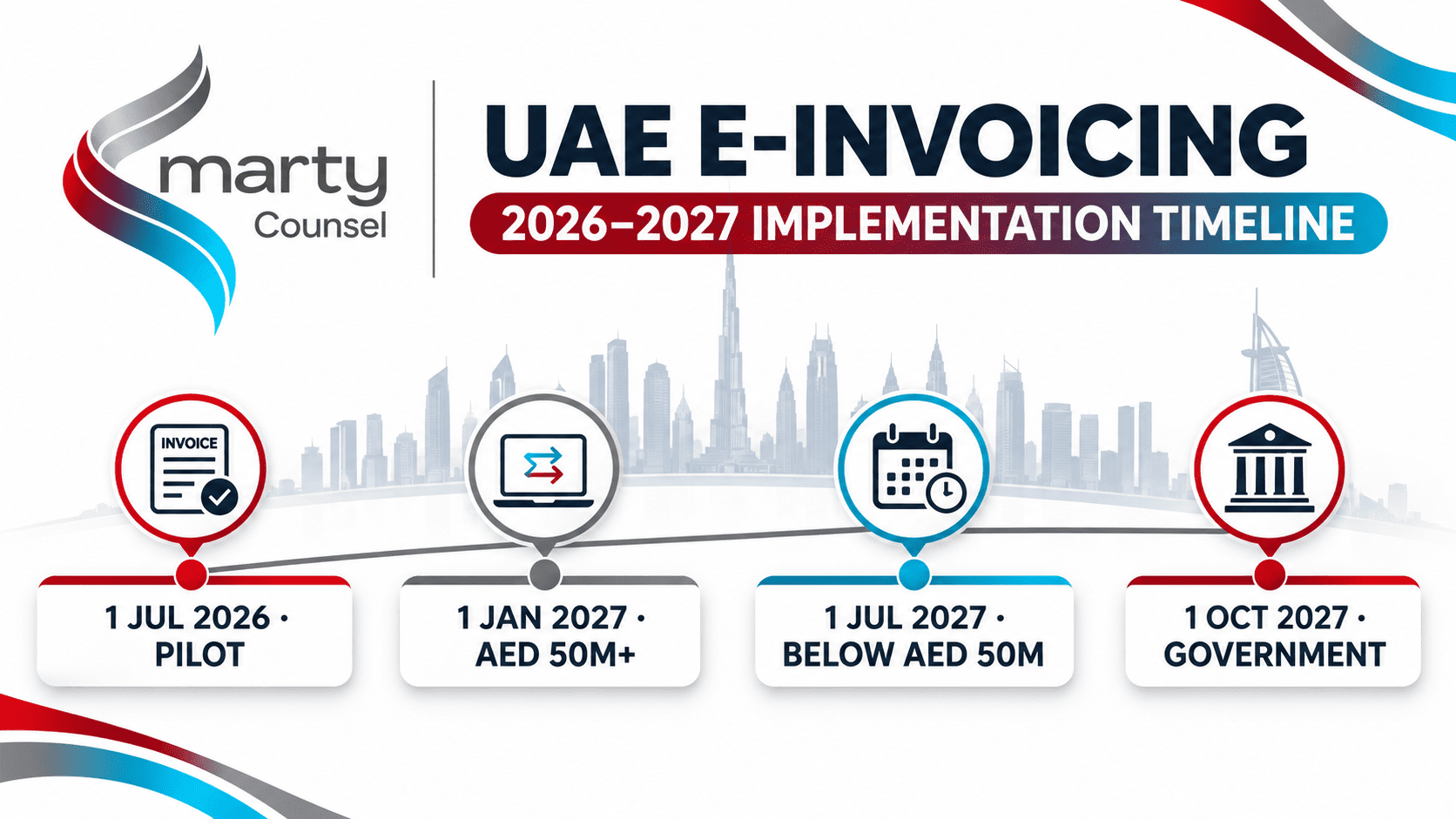
The UAE e-invoicing implementation timeline phases begin with a pilot and voluntary adoption from 1 July 2026, followed by mandatory implementation for large businesses from 1 January 2027, businesses below the AED 50 million revenue threshold from 1 July 2027, and government entities from 1 October 2027. The date that applies to your organisation depends mainly on its revenue category and whether its transactions are within the scope of the UAE Electronic Invoicing System.
This guide explains the deadlines, the meaning of the AED 50 million threshold, who must comply, how to appoint an Accredited Service Provider (ASP), and what businesses should do before their implementation date.
Prepared for UAE businesses by Smarty Counsel · Last reviewed: 18 November 2026 · Based on Ministry of Finance and Federal Tax Authority publications
UAE E-Invoicing Implementation Timeline: All Phases at a Glance
The Ministry of Finance has introduced the UAE e-invoicing system through a phased rollout. There are three main mandatory implementation groups: businesses with annual revenue of AED 50 million or more, businesses with revenue below AED 50 million, and government entities.
| Phase or group | Who it covers | Deadline to appoint an ASP | Mandatory implementation date |
|---|---|---|---|
| Pilot programme | Selected businesses invited by the Ministry of Finance | As arranged for invited participants | Started 1 July 2026 |
| Voluntary adoption | Any in-scope person choosing to adopt early, regardless of revenue | Before voluntary onboarding and testing | Available from 1 July 2026 |
| Phase 1 | In-scope persons with annual revenue of AED 50 million or more | 30 October 2026 | 1 January 2027 |
| Phase 2 | In-scope persons with annual revenue below AED 50 million | 31 March 2027 | 1 July 2027 |
| Government entities | Government entities subject to the system | 31 March 2027 | 1 October 2027 |
The Phase 1 appointment date above follows Ministerial Decision No. 66 of 2026, which amends the original date to 30 October 2026. The Ministry’s Version 2.0 guidance table dated 26 October 2026 displays 31 October 2026 for this appointment deadline. This is a one-day discrepancy between official materials; the amending decision’s express wording is used here. Businesses dealing with a specific late-appointment issue should seek confirmation from the FTA or Ministry of Finance.
1. Pilot and Voluntary E-Invoicing Phases in the UAE
Pilot programme: from 1 July 2026
The Ministry of Finance began the pilot programme on 1 July 2026. The pilot is for selected persons whom the Ministry contacts and invites to participate. A business becomes part of the pilot only after it agrees in writing. It is not an open registration programme in which every business can automatically claim pilot status.
Businesses selected for the pilot must follow the UAE technical requirements. The purpose is to test the complete invoice exchange and tax-data reporting process, identify operational issues and prepare the system before mandatory implementation.
Voluntary adoption: from 1 July 2026
Separate from the selected pilot, any person may choose to implement e-invoicing voluntarily from 1 July 2026, regardless of annual revenue. A business that adopts voluntarily must still follow the applicable technical requirements. The Ministry’s guidance says e-invoicing administrative penalties apply from the date the person is required to implement the system on a mandatory basis, not merely because it has chosen to participate voluntarily.
Early adoption can give a business time to test its accounting software, clean customer and supplier records, review invoice fields and train staff before its mandatory date. It should not be treated as a substitute for confirming the correct phase and completing the required onboarding.
2. Phase 1: Businesses With Annual Revenue of AED 50 Million or More
30 October 2026
Deadline to appoint an Accredited Service Provider under Ministerial Decision No. 66 of 2026.
1 January 2027
Mandatory implementation date for in-scope businesses in this revenue category.
Act immediately
As at 18 November 2026, the ASP appointment deadline has passed and the go-live date is approaching.
Phase 1 covers a person within the scope of the UAE e-invoicing system whose revenue is equal to or greater than AED 50 million. The business was required to appoint an ASP by 30 October 2026 and must implement the electronic invoicing system by 1 January 2027.
The May 2026 amendment moved the original ASP appointment date from 31 July 2026 to 30 October 2026. It did not move the 1 January 2027 implementation date. The Ministry later reiterated that the Phase 1 implementation date remained unchanged.
What should a Phase 1 business do now?
- Confirm whether the business is in scope and verify the revenue basis using its latest accounting-period records.
- Contact the selected ASP immediately and confirm the contractual and onboarding position.
- Check that the business has its Tax Identification Number (TIN) and has completed the relevant EmaraTax onboarding steps.
- Map accounts receivable and accounts payable processes, invoice data, credit notes and approval flows.
- Complete system integration and end-to-end testing. Do not leave testing until the final days before go-live.
- Agree who will monitor failed exchanges, rejected data, confirmation messages and corrections after go-live.
3. Phase 2: Businesses With Annual Revenue Below AED 50 Million
31 March 2027
Deadline for in-scope businesses below the AED 50 million revenue threshold to appoint an ASP.
1 July 2027
Mandatory implementation date for this group.
Start early
Review invoice data, accounting software, customer records and supplier processes before onboarding.
Phase 2 covers persons within the scope of the system whose annual revenue is below AED 50 million. These businesses must appoint an ASP by 31 March 2027 and implement the system by 1 July 2027.
The later go-live date does not mean that a small or medium-sized business is automatically exempt. The key questions are whether it carries out business transactions covered by the rules and which revenue category applies. The system can apply even if the business is not registered for VAT.
How SMEs can prepare before March 2027
SMEs should use the remaining preparation period to review how invoices are created, approved, sent, received and recorded. Businesses using spreadsheets or basic accounting software should check with potential ASPs whether their existing systems can provide the required invoice data and how any integration or manual data-transfer process will work.
They should also clean customer and supplier master data, confirm legal names and identifiers, review credit-note procedures and make sure the finance team knows how to deal with rejected invoices or failed transmission messages.
4. Government Entity Phase: 1 October 2027
Government entities subject to the UAE electronic invoicing system have a separate implementation date. They must appoint an ASP by 31 March 2027 and implement the system by 1 October 2027.
The government-entity phase matters to both public bodies and businesses that supply goods or services to them. Business-to-government transactions are included in the framework, so a supplier should not assume that an invoice is outside the system simply because its customer is a government entity.
The rules contain an exclusion for certain government activities carried out in a sovereign capacity and not in competition with the private sector. That is a specific legal exclusion, not a blanket exemption for every government transaction.
5. How Is the AED 50 Million Revenue Threshold Calculated?
The AED 50 million threshold is based on revenue, not net profit. The Ministry of Finance guidelines define revenue as the gross income earned by a person during its most recent Accounting Period, based on financial statements prepared under applicable UAE legislation. If those financial statements are not available, other documentation acceptable to the FTA may be used.
This distinction matters. A company may have high revenue but low net profit because its expenses are significant. The revenue test is not a test of the amount left after deducting wages, rent, supplier costs or other operating expenses.
Does VAT registration determine the phase?
No. VAT registration status does not, by itself, decide whether a person is within the scope of UAE e-invoicing. The Ministry’s guidelines state that persons carrying out business transactions in the UAE may be in scope regardless of whether they are VAT registered. The FTA also explains that B2B transactions involving businesses that are not VAT registered can still fall within the system.
VAT registration and e-invoicing scope are separate questions. A business should assess both its transaction types and its revenue category rather than assuming that no VAT registration means no e-invoicing obligation.
6. Who Must Use the UAE E-Invoicing System?
The framework broadly applies to persons conducting business in the UAE in respect of business transactions, unless a specific exclusion applies. It covers relevant business-to-business (B2B) and business-to-government (B2G) transactions, and the Ministry’s transaction matrix also identifies government-to-business and government-to-government flows as in scope.
| Transaction type | General treatment in the Ministry’s transaction matrix | Practical meaning |
|---|---|---|
| B2B | In scope | A business supplies another business. |
| B2G | In scope | A business supplies a government buyer. |
| G2B / G2G | In scope, subject to exclusions | A government supplier transacts with a business or another government entity. |
| B2C | Not in the current general mandatory scope | A business supplies a consumer acting in a personal capacity. |
For example, a consultancy issuing invoices to corporate clients, a wholesaler supplying a retailer, or a contractor billing a government department may have transactions within the system. A retailer’s ordinary sale to an individual consumer is treated differently under the current transaction matrix.
One person subject to the system must appoint one ASP for both its outgoing invoices (accounts receivable) and incoming invoices (accounts payable). A business should therefore consider the impact on its purchase and sales processes, not only the invoices it sends to customers.
7. What Counts as an Electronic Invoice in the UAE?
A UAE e-invoice is structured invoice data that can be exchanged and processed electronically through the approved system. It is not simply a paper invoice saved as a PDF or a document emailed to a customer.
The FTA explains that PDF files, Word documents, images, scanned copies and email messages are not electronic invoices for this framework. The UAE system uses structured, machine-readable data based on the PINT-AE specifications and the applicable UAE data dictionary. The standard output is an XML-based electronic invoice.
| Document or format | Is it an e-invoice by itself? | Why it matters |
|---|---|---|
| PDF invoice attached to an email | No | It is an unstructured document and does not meet the structured exchange requirement on its own. |
| Scanned paper invoice or invoice image | No | A picture of an invoice is not machine-readable structured invoice data. |
| Word document | No | A word-processing file does not become a compliant e-invoice simply because it is sent electronically. |
| Structured invoice data exchanged through the UAE system | Yes, when compliant | The invoice is validated, transmitted and reported through the applicable ASP and Peppol arrangements. |
8. How the UAE Peppol Five-Corner E-Invoicing Model Works
The UAE uses a decentralised five-corner model. The supplier and buyer use their respective ASPs to exchange invoice data, while the required tax data is also reported to the government platform. Businesses do not need to connect directly to the UAE Peppol Authority; the ASP handles the network connection on their behalf.
The five corners in plain English
- Corner 1 – Supplier: the supplier enters invoice information into its accounting or business software and starts the invoicing process.
- Corner 2 – Supplier’s ASP: the sending ASP checks the invoice data, validates it against the relevant requirements and transmits it across the Peppol network.
- Corner 3 – Buyer’s ASP: the receiving ASP collects and validates the invoice data and delivers it to the buyer’s software.
- Corner 4 – Buyer: the buyer receives the electronic invoice through its software and handles it through its accounts payable process.
- Corner 5 – Government reporting: the relevant invoice tax data is reported to the Ministry of Finance and Federal Tax Authority platform for collection and processing.
The UAE uses PINT-AE, the localised Peppol invoice specification, to define the structured document requirements. A business should ask its ASP how the required data will be extracted from its current software and how successful or failed exchange and reporting messages will be returned.
9. How to Prepare for UAE E-Invoicing: Step-by-Step Implementation
The Ministry’s readiness guidance sets out four core steps: understand the requirements, select an ASP, test invoice exchange and reporting, and go live. Businesses should also maintain an ongoing process for updating information and resolving issues.
Step 1: Confirm scope, phase and invoice processes
Start by identifying the legal entities and business activities involved. Review the latest accounting-period revenue, customer types, supplier types, government contracts and any specific exclusions. Map the sales invoice process and the purchase invoice process separately so that both sending and receiving requirements are covered.
Step 2: Review accounting software and invoice data
Check whether the existing accounting or ERP system can provide the information required by the UAE data dictionary. Review customer and supplier legal names, tax identifiers, addresses, invoice dates, supply details, tax categories, amounts, currencies and credit-note records. The exact required fields depend on the document type and transaction scenario.
Identify missing or inconsistent master data before integration begins. A technically connected system can still produce rejected invoices if core customer, supplier or tax information is incomplete or inaccurate.
Step 3: Choose an Accredited Service Provider
Check the Ministry of Finance’s official ASP information and compare providers based on their accreditation status, system compatibility, support, integration approach, security, service availability, implementation plan and total cost. Ask for a clear explanation of how the provider will support both accounts receivable and accounts payable.
Confirm the commercial agreement, responsibilities, service levels, error handling, data access, support escalation and any third-party technology arrangements. Do not choose a provider based only on a low headline fee.
Step 4: Complete FTA and EmaraTax onboarding
The Ministry’s guidance says the business or government entity should initiate its onboarding process through EmaraTax. The organisation will need its TIN. For a person already registered with the FTA, the TIN is the first 10 digits of the issued TRN. A person in scope but not registered for a tax type may need to register with the FTA to obtain a TIN.
During onboarding, the person selects its ASP through the relevant EmaraTax process and obtains a Peppol participant identifier through the provider. Follow the current FTA portal instructions because the onboarding screens and provider list may be updated.
Step 5: Integrate and test the full process
Agree how invoice data will move from the accounting or ERP system to the ASP, how incoming supplier invoices will reach the buyer’s software, and how confirmation messages will be managed. Test successful invoices, rejected data, credit notes, tax reporting, corrections and exceptions. Reconfigure internal approval workflows if the new process changes who reviews or releases an invoice.
Step 6: Go live and monitor compliance
Before go-live, assign named owners for invoice transmission, incoming invoice review, error resolution, customer and supplier data changes, and record retention. Agree how the ASP will notify the business about failed exchanges or reporting. After go-live, review exception reports regularly and retain the required electronic invoices, electronic credit notes and associated data so they can be retrieved and produced to the FTA when requested.
10. UAE E-Invoicing Penalties: What Businesses Need to Know
Failure to implement the UAE e-invoicing system or to meet ongoing invoice obligations can result in administrative penalties. Cabinet Decision No. 173 of 2026 sets out a revised penalty schedule. It replaces Cabinet Decision No. 106 of 2025 from the effective date specified in the new decision.
| Type of violation | Penalty described in Cabinet Decision No. 173 of 2026 |
|---|---|
| Failure by an issuer or recipient to implement the system, including failure to appoint an ASP; or failure by a recipient to maintain its recipient obligations | AED 5,000 for the first instance, plus AED 5,000 for each month or part of a month that non-compliance continues, capped at AED 50,000 within any 12 consecutive months. |
| Failure by an issuer to issue and transmit an electronic invoice through the system | AED 100 per electronic invoice, up to AED 5,000 per calendar month. |
| Failure by an issuer to issue and transmit an electronic credit note through the system | AED 100 per electronic credit note, up to AED 5,000 per calendar month. |
| Failure by an issuer or recipient to notify its appointed ASP of changes to data registered with the Authority | AED 250 for each day of delay or part thereof, up to AED 5,000 per calendar month. |
Cabinet Decision No. 173 also states that the penalties under that decision do not apply to persons that issue, transmit, share, exchange or report electronic invoices and electronic credit notes on a voluntary basis under the applicable decisions. That does not remove the technical requirements of voluntary participation.
Effective-date note: Cabinet Decision No. 173 states that it enters into force on the day following its publication in the Official Gazette. Check the official publication and applicable effective date before assessing a specific historical breach or penalty exposure. The table above summarises the amounts written in the decision; it is not a calculation of any particular business’s liability.
11. Special Cases and Exclusions to Check Before Choosing Your Phase
The phase dates do not mean that every invoice or transaction is automatically covered. The legal framework contains specific exclusions and special rules. A business should review its actual transactions rather than applying a broad assumption to every invoice.
Business-to-consumer transactions
Transactions in which a business supplies a consumer acting in a personal capacity are outside the current general mandatory B2B/B2G scope shown in the Ministry’s guidance. A business that only makes consumer transactions should still check the latest ministerial decisions and whether its business model includes any separate B2B or B2G transactions.
Transactions between members of the same VAT tax group
Ministerial Decision No. 197 of 2026 provides a 24-month period starting on 1 January 2027 during which electronic invoicing obligations do not need to be implemented for transactions between members of the same VAT tax group. This is temporary relief for those intra-group transactions. It does not remove other transactions of the business from the system, and it does not automatically cover related companies that are not members of the same VAT tax group.
Other specific exclusions
The legislation identifies certain transactions that may be excluded, including qualifying government sovereign activities, specified airline passenger and ancillary services, certain international airline freight services for a limited period, and financial services that are exempt from VAT or subject to VAT at the zero rate under the relevant VAT rules. The legal conditions matter; do not treat these categories as blanket exemptions for every transaction involving a government entity, airline or financial institution.
Newly established businesses
A newly established person that is within the scope of electronic invoicing must appoint an ASP and complete onboarding before issuing its first invoice, regardless of its date of establishment. It should not wait for a future general phase date if the rules require it to be ready before its first invoice.
12. UAE E-Invoicing Readiness Checklist for Businesses
Use this checklist to organise the work with your finance team, software provider and ASP.
- Confirm the organisation’s e-invoicing scope and mandatory implementation phase.
- Verify gross income for the most recent Accounting Period and retain the supporting financial records.
- Confirm whether the business has a TIN and whether its EmaraTax details are current.
- Review the official list and accreditation status of potential ASPs.
- Agree the ASP contract, service levels, data responsibilities and support arrangements.
- Map both outgoing invoices and incoming supplier invoices.
- Check customer, supplier, tax and invoice master data for missing or inconsistent fields.
- Confirm whether accounting or ERP integration, configuration or workflow changes are required.
- Complete EmaraTax onboarding and obtain the Peppol participant identifier through the ASP process.
- Test invoice exchange, electronic credit notes, tax-data reporting and confirmation messages.
- Assign responsibility for errors, rejected invoices, data changes and escalation.
- Confirm that electronic records can be securely retained, retrieved and produced to the FTA when requested.
- Train accounts receivable, accounts payable, finance and relevant operational staff before go-live.
Accounting records and invoice controls are a practical part of readiness. A business may need to update its bookkeeping procedures, approval controls and supplier records before the technical connection is tested. Smarty Counsel provides accounting and bookkeeping services for UAE businesses and can discuss the finance-process preparation relevant to your organisation.
13. Frequently Asked Questions About the UAE E-Invoicing Timeline
1. When does mandatory e-invoicing start in the UAE?
Mandatory implementation starts on 1 January 2027 for in-scope persons with annual revenue of AED 50 million or more. It starts on 1 July 2027 for in-scope persons below AED 50 million, and on 1 October 2027 for government entities subject to the system.
2. What is the UAE e-invoicing deadline for businesses with revenue below AED 50 million?
They must appoint an Accredited Service Provider by 31 March 2027 and implement the electronic invoicing system by 1 July 2027, provided they are within the scope of the rules.
3. What is the Phase 1 e-invoicing deadline for companies above AED 50 million?
The amended legal decision sets 30 October 2026 as the ASP appointment deadline and 1 January 2027 as the implementation date. The Ministry’s Version 2.0 guidance table shows 31 October for the appointment deadline, creating a one-day discrepancy in official materials. The amending decision’s wording is used in this guide.
4. Does a business need to be VAT registered to use e-invoicing?
No. The framework can cover persons conducting business transactions in the UAE regardless of VAT registration status, unless a specific exclusion applies. The business may need to obtain a TIN through the FTA onboarding process.
5. Is a PDF invoice considered an e-invoice in the UAE?
No. A PDF, Word document, scanned invoice, image or email is not an e-invoice by itself. The system requires structured, machine-readable invoice data that is exchanged through the approved framework.
6. Can a small business start e-invoicing before July 2027?
Yes. Voluntary adoption has been available from 1 July 2026 for persons regardless of revenue. A voluntary participant must still meet the applicable technical requirements.
7. Does a business need separate ASPs for outgoing and incoming invoices?
The Ministry’s guidelines state that a person within scope must appoint one ASP for both sending and receiving electronic invoices. The business should confirm with its provider how both accounts receivable and accounts payable workflows will be supported.
8. What does the AED 50 million threshold mean?
The Ministry defines revenue by reference to gross income earned during the most recent Accounting Period, based on financial statements prepared under applicable UAE legislation or other documentation acceptable to the FTA if those statements are unavailable. It is not a net-profit threshold.
9. Are transactions within a VAT tax group covered from January 2027?
Ministerial Decision No. 197 of 2026 provides a 24-month period starting 1 January 2027 during which electronic invoicing obligations do not need to be implemented for transactions between members of the same VAT tax group. Other transactions by those businesses may still be subject to the applicable phase.
10. What should a business do if it has missed its ASP appointment deadline?
It should contact an ASP and the FTA or a qualified UAE tax adviser promptly, complete the required onboarding steps and keep records of its corrective actions. It should not assume that the implementation date has been extended.
Conclusion: Prepare for the UAE E-Invoicing Phase That Applies to Your Business
The UAE e-invoicing implementation timeline is based on a phased rollout, but the work required is broader than choosing a go-live date. Businesses need to confirm their scope and revenue category, appoint an accredited provider by the relevant deadline, complete onboarding, prepare structured invoice data, test both invoice exchange and government reporting, and make sure finance teams can manage the process after launch.
For large businesses, the immediate priority is readiness for 1 January 2027. Businesses below AED 50 million should use the time before 31 March and 1 July 2027 to choose an ASP and prepare their accounting and invoice processes. Government entities should plan for the 1 October 2027 implementation date.
Need help preparing your finance processes?
Smarty Counsel supports UAE businesses with accounting and bookkeeping processes that help maintain organised financial records and reliable invoice workflows. Discuss your accounting requirements with the team before your e-invoicing implementation date.
Explore accounting and bookkeeping services or contact Smarty Counsel.