Do Tax Groups Need E-Invoicing in the UAE? 24-Month Relief Explained
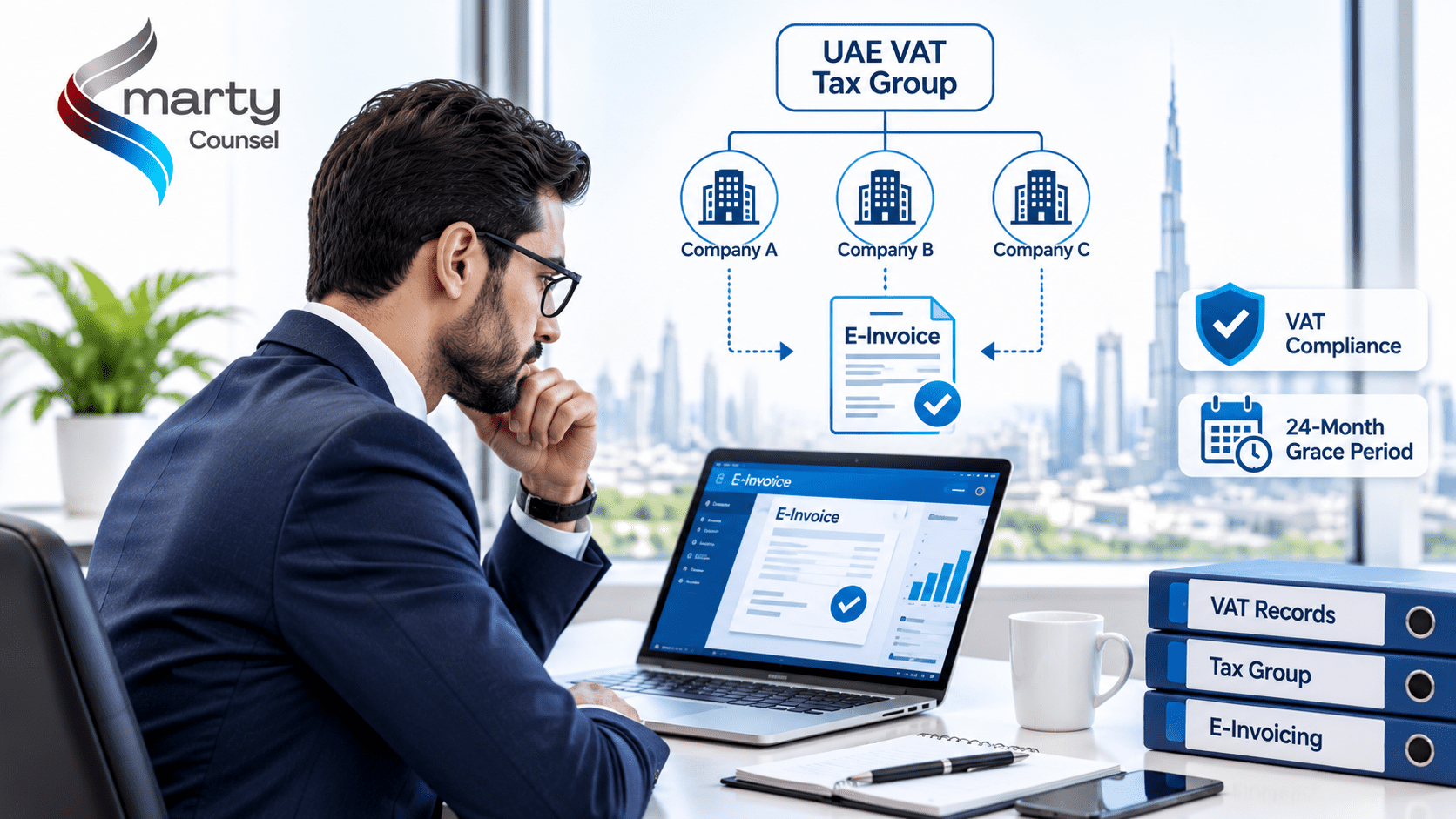
Yes. UAE VAT Tax Groups must prepare for the e-invoicing system. However, Ministerial Decision No. 197 of 2026 provides a temporary 24-month grace period for business transactions carried out between members of the same registered VAT Tax Group.
The grace period starts on 1 January 2027 and runs through 31 December 2028. During this period, the e-invoicing obligations do not have to be implemented for those intra-group transactions.
This is not a permanent exemption for the whole group. In-scope transactions with customers and suppliers outside the VAT Tax Group, such as applicable B2B and B2G transactions, remain subject to the normal e-invoicing rules when the relevant member reaches its mandatory phase. Each Tax Group member must also be onboarded separately and use its own Tax Identification Number (TIN) and Peppol participant identifier.
What Is a Tax Group in the UAE?
For UAE e-invoicing purposes, a Tax Group means two or more persons registered with the Federal Tax Authority (FTA) as a single Taxable Person under the UAE VAT legislation.
This is important because an ordinary corporate group is not automatically a VAT Tax Group. Companies may share the same owner, parent company, directors or brand and still be separate businesses for this rule. The temporary e-invoicing relief applies to transactions between persons who are members of the same registered Tax Group under the VAT Decree-Law.
Before applying the relief, check the group’s actual FTA VAT registration and confirm which legal entities are recorded as members. Do not rely only on a group organisation chart or common ownership.
The Ministry of Finance defines a Tax Group in its UAE Electronic Invoicing Guidelines, Version 2.0. You can also review the FTA’s Tax Groups Guide.
What Did Ministerial Decision No. 197 of 2026 Change?
On 19 October 2026, the Ministry of Finance announced Ministerial Decision No. 197 of 2026. It amended parts of Ministerial Decision No. 243 of 2025, which governs the UAE Electronic Invoicing System. The amendment took effect on 1 October 2026.
One of its key changes is the temporary relief for business transactions between members of the same Tax Group. The period begins on 1 January 2027 and lasts 24 months.
The Ministry’s announcement describes these transactions as Excluded Transactions during that period. The more detailed October 2026 Guidelines explain the practical effect: the grace period delays the implementation of e-invoicing obligations for intra-group transactions, but it does not remove those transactions from the system’s scope permanently. When the grace period expires, the e-invoicing requirements apply in full in accordance with the applicable mandatory implementation phase.
The 24-month period is a temporary implementation grace period, not a permanent exemption.
Important legal distinction: the Ministry’s Guidelines expressly say that the grace period affects the timing of compliance only. It does not remove intra-group transactions from the e-invoicing system’s scope or change the obligations for a member’s other business transactions.
Which Transactions Receive the 24-Month Tax Group Relief?
The relief is transaction-specific. It applies to business transactions carried out between members of the same registered VAT Tax Group. It does not cover every transaction made by a company simply because that company belongs to a wider corporate group.
| Transaction | Does the temporary relief apply? | What the business should do |
|---|---|---|
| Member A supplies goods or services to Member B of the same registered VAT Tax Group | Yes, from 1 January 2027 to 31 December 2028 | Keep supporting accounting and transaction records. Plan for e-invoicing after the grace period. |
| Member A sells to an in-scope business or government customer outside the VAT Tax Group | No | Apply the normal e-invoicing rules from the member’s applicable mandatory date. |
| Member B buys goods or services from an in-scope business supplier outside the VAT Tax Group | No | Prepare to receive in-scope e-invoices through the member’s endpoint when its requirements begin. |
| Two companies have the same owner but are not both registered members of the same VAT Tax Group | No, not on the basis of common ownership alone | Assess the transaction under the ordinary e-invoicing scope and timeline. |
| Transaction between members of the same VAT Tax Group after 31 December 2028 | The temporary relief has ended | Apply the e-invoicing requirements in accordance with the applicable mandatory implementation phase. |
Does the relief cover all related companies?
No. A parent company and its subsidiaries do not qualify merely because they are related parties. The companies must be registered members of the same VAT Tax Group recognised by the FTA.
For example, if Company A and Company B are members of the same VAT Tax Group but Company C is a separately registered company owned by the same parent, the temporary relief can apply to qualifying transactions between A and B. It does not automatically apply to transactions between A and C or B and C.
Does the 24-Month Relief Exempt the Whole Tax Group from E-Invoicing?
No. This is the most important point for finance teams to understand.
The relief only concerns business transactions between members of the same VAT Tax Group. It does not remove the e-invoicing obligations for a member’s transactions with outside businesses or government entities when those transactions are within scope.
A Tax Group member may therefore have both types of transactions at the same time:
- Intra-group transactions: benefit from the temporary 24-month grace period.
- External B2B or B2G transactions: follow the mandatory e-invoicing rules and the relevant implementation date.
Do not switch off e-invoicing for an entire company just because some of its internal transactions qualify for the relief. Your accounting and ERP setup must distinguish between qualifying intra-group activity and transactions with parties outside the group.
Do VAT Tax Group Members Need Separate E-Invoicing Onboarding?
Yes. The Ministry of Finance Guidelines say each member of a Tax Group needs to be onboarded for e-invoicing. Each member has its own TIN, which generates its individual Peppol participant identifier. The Guidelines also state that each member may onboard with a different ASP.
This means the representative member should not assume that one group-level onboarding automatically completes the setup for every legal entity in the group.
The FTA’s e-invoicing FAQs also state that each VAT Tax Group member must have an endpoint through a UAE Accredited Service Provider. The endpoint details should identify the particular member conducting the transaction.
Each member has its own electronic identity. The group should map internal and external invoice flows separately.
TIN, Group TRN and Peppol Endpoint: What Is the Difference?
A VAT Tax Group uses a group Tax Registration Number (TRN) for VAT purposes. E-invoicing also requires the individual electronic identity of each group member.
The Ministry’s Guidelines explain that each Tax Group member has its own TIN and its own Peppol participant identifier. The FTA also clarifies that the group TIN should not be used as the e-invoicing identifier for every member.
| Identifier or setup | What it is used for |
|---|---|
| Group TRN | The VAT Tax Group’s TRN. The FTA’s FAQ says the group TRN should be provided for the invoice, while the endpoint details identify the individual member carrying out the transaction. |
| Member’s TIN | The individual member’s Tax Identification Number used for its e-invoicing participant identification. |
| Peppol participant identifier | The electronic address used to identify the specific member on the Peppol network. |
| ASP endpoint | The member’s connection for sending and receiving electronic invoices through its accredited service provider. |
Because tax identifiers and invoice fields serve different purposes, ask your ASP to confirm how your accounting or ERP system will map the group TRN, each member’s TIN, supplier details and the correct endpoint. Do not substitute the representative member’s identifier for every group member.
What Are the UAE E-Invoicing Deadlines for Tax Group Members?
The 24-month intra-group grace period does not replace the wider phased rollout. Each member must assess its own in-scope transactions and applicable implementation phase. The general dates are:
| Category | ASP appointment deadline | Mandatory go-live |
|---|---|---|
| Person with revenue of AED 50 million or more | 30 October 2026 | 1 January 2027 |
| Person with revenue below AED 50 million | 31 March 2027 | 1 July 2027 |
| In-scope government entity | 31 March 2027 | 1 October 2027 |
The FTA defines revenue for this purpose as gross income earned by a Person during the most recent Accounting Period, based on financial statements prepared under the applicable UAE rules or other documentation acceptable to the FTA if those statements are unavailable.
Tax Group revenue point: Do not assume that the representative member’s revenue, the consolidated group figure or one member’s standalone revenue automatically determines the phase for every other member. The implementation rules refer to the revenue of a Person, while the Ministry requires each group member to be onboarded separately. Have the applicable revenue basis and phase documented for each member with your ASP or UAE tax adviser.
The Phase 1 appointment date of 30 October 2026 has passed as of 21 November 2026. The go-live date for that phase remains 1 January 2027. Decision No. 197 did not move the general implementation dates.
Practical Example: How the Relief Works for a VAT Tax Group
Assume three UAE companies—Company A, Company B and Company C—are registered members of the same VAT Tax Group.
- Company A provides a service to Company B. This is a transaction between members of the same registered VAT Tax Group. The 24-month grace period applies to the e-invoicing implementation obligation for this transaction from 1 January 2027 through 31 December 2028.
- Company A sells goods to an unrelated UAE business customer. This is an in-scope external transaction. The Tax Group relief does not cover it. Company A must follow the e-invoicing requirements applicable to its phase.
- Company B buys services from an unrelated UAE business supplier. This is also an in-scope external transaction. Company B must prepare to receive in-scope e-invoices through its own endpoint when its applicable requirements begin.
- Company D has the same parent as A, B and C but is not a member of their VAT Tax Group. The shared parent alone does not qualify Company D’s transactions for the 24-month relief.
This example shows why a group-wide statement such as “we are exempt from e-invoicing until 2029” is unsafe. The correct treatment depends on who is transacting with whom and whether both parties are members of the same VAT Tax Group.
Does the Tax Group Relief Remove Other VAT and Accounting Responsibilities?
No. The temporary relief concerns the implementation of e-invoicing for qualifying intra-group business transactions. It should not be treated as a cancellation of the group’s wider tax, accounting or recordkeeping responsibilities.
Group members should continue to keep accurate records of intercompany activity, including contracts, service descriptions, recharge calculations, supporting documents, payment or settlement records and reconciliation entries, as relevant to their circumstances.
The VAT treatment of supplies between VAT Tax Group members is governed by the VAT grouping rules. The e-invoicing amendment does not replace those rules. It also does not remove the e-invoicing requirements for a member’s other in-scope transactions with external businesses.
Separately, amended Article 11 requires persons subject to the e-invoicing system to retain electronic invoices, electronic credit notes and associated data for the period prescribed under the Tax Procedures Law and to produce those records to the FTA upon request. Decision No. 197 removed the former requirement to store the data physically within the UAE; it did not remove the record-retention obligation.
What Should a UAE Tax Group Do Now?
The temporary relief gives finance teams more time to prepare their intra-group processes. It should be used to organise data and systems, not to postpone the entire e-invoicing project.
- Confirm the registered VAT Tax Group. Obtain the current FTA registration details and list every legal entity that is a member. Do not rely on common ownership alone.
- Map all transaction flows. Separate member-to-member transactions from sales to and purchases from external businesses and government entities.
- Build a member-by-member identifier register. Record each legal entity’s TIN, Peppol participant identifier, endpoint, ERP or accounting system and relevant contact.
- Confirm the implementation phase. Review the revenue test and applicable deadline for each member. Document the basis used rather than assuming a single group-wide deadline.
- Select an ASP for each member. The Ministry’s Guidelines allow group members to onboard with different ASPs. A group can assess whether using one provider would simplify reporting and support, but should not mistake that choice for a legal requirement.
- Prepare the accounting and ERP systems. Check customer and supplier data, member identifiers, invoice categories, tax codes, credit notes and integration methods.
- Keep evidence of the relief decision. Retain the VAT Tax Group registration record and a documented method for identifying transactions between members of the same group.
- Plan for 1 January 2029. Work with the ASP and finance team to bring qualifying intra-group transactions into the required e-invoicing process when the grace period expires.
What Happens to Tax Group Transactions After 31 December 2028?
The temporary grace period runs for 24 months from 1 January 2027. It therefore ends on 31 December 2028.
The Ministry’s Guidelines state that when the grace period expires, the e-invoicing requirements apply in full to business transactions between members of the same VAT Tax Group, in accordance with the applicable mandatory implementation phase.
For that reason, groups should not permanently design their systems around excluding intercompany transactions. They should use 2027 and 2028 to prepare their member records, transaction mapping, data quality, ASP arrangements and intercompany workflows so the transition is manageable.
Frequently Asked Questions
Do tax groups need e-invoicing in the UAE?
Yes. UAE VAT Tax Groups must prepare for e-invoicing. Business transactions between members of the same registered VAT Tax Group have a temporary 24-month grace period from 1 January 2027 to 31 December 2028. Transactions with outside businesses remain subject to the normal rules when the relevant member’s phase begins.
Are transactions between VAT Tax Group members exempt from e-invoicing?
They receive temporary relief for 24 months beginning 1 January 2027. The Ministry’s Guidelines clarify that this is a grace period affecting the timing of compliance. It is not a permanent removal of intra-group transactions from the system’s scope.
Does the relief apply to all companies owned by the same parent?
No. The companies must be registered members of the same VAT Tax Group with the FTA. Common ownership or membership in a wider corporate group is not enough by itself.
Does each VAT Tax Group member need its own ASP?
Each member must be onboarded and have its own e-invoicing identity and endpoint. The Ministry’s Guidelines state that different Tax Group members may onboard with different ASPs. A group may choose a common ASP for operational convenience, but the guidance does not require every member to use the same provider.
Does a VAT Tax Group use one TRN or separate TINs for e-invoicing?
The group has a group TRN for VAT purposes, while each member has its own TIN for e-invoicing participant identification. The FTA says the endpoint details must identify the member conducting the transaction. Ask your ASP to map the group TRN, member TIN and endpoint correctly.
Can a company claim the relief if it belongs to a Corporate Tax group?
Do not assume so. The e-invoicing definition of Tax Group refers to persons registered with the FTA as a single Taxable Person under the VAT Decree-Law. A Corporate Tax group arrangement alone does not establish that the company is a member of a VAT Tax Group.
Do external sales and purchases receive the same 24-month relief?
No. The relief is limited to business transactions between members of the same VAT Tax Group. Transactions with external customers and suppliers must be assessed under the normal UAE e-invoicing scope and implementation timeline.
When does the Tax Group grace period end?
The 24-month period runs from 1 January 2027 through 31 December 2028. The Ministry’s Guidelines say e-invoicing requirements apply in full to intra-group transactions upon expiry, subject to the applicable mandatory implementation phase.
Does the relief remove VAT or accounting recordkeeping requirements?
No. The relief is about the timing of e-invoicing obligations for qualifying intra-group transactions. Businesses must continue to maintain the records required under the applicable VAT, Corporate Tax and accounting rules.
Can a Tax Group use one ASP for all its members?
A group can choose to use one provider if that arrangement works for its systems and contracts. However, the Ministry’s Guidelines state that each member may onboard with a different ASP. Each member still needs its own TIN and Peppol participant identifier.
Prepare Your VAT Tax Group for UAE E-Invoicing
Smarty Counsel supports UAE businesses with accounting, bookkeeping, VAT-related administration and financial record preparation. We can help your finance team organise member records, map internal and external transactions and prepare accounting information for an e-invoicing implementation project.
Smarty Counsel is not an Accredited Service Provider. Businesses must select an ASP from the Ministry of Finance’s official accredited list.
Discuss Your RequirementsRead the UAE E-Invoicing GuideOfficial Sources and Further Reading
- Ministry of Finance — Ministerial Decision No. 197 of 2026 (19 October 2026)
- Ministry of Finance — UAE Electronic Invoicing Guidelines, Version 2.0 (26 October 2026), especially sections 6.3.2 and 13.2
- Federal Tax Authority — UAE e-Invoicing FAQs
- Federal Tax Authority — Tax Groups Guide for VAT
- Ministry of Finance — Official UAE eInvoicing portal and legislation
- Ministerial Decision No. 66 of 2026 — Amendment to the Phase 1 ASP appointment deadline
Editorial responsibility and scope: Smarty Counsel takes responsibility for the accuracy and review of the information presented in this guide, based on the official UAE Ministry of Finance and Federal Tax Authority materials cited above and the review date shown. The article is general information, not an opinion on a particular company’s tax-group status or a substitute for advice based on its registration, transactions and financial records. The official legislation and current FTA or Ministry guidance take precedence if they change or differ from this summary. Businesses should confirm their specific position before changing invoice or accounting procedures.