UAE e-invoicing is changing how every business in the country issues, sends and stores e-invoices. Under the Electronic Invoicing System set up by the Ministry of Finance (MoF), paper and PDF invoices are being replaced by structured digital e-invoices that are validated and reported through government-approved providers. If you run a company in Dubai, Abu Dhabi, Sharjah or anywhere else in the UAE, e-invoices will affect how you bill customers, record expenses and keep your books.
In this guide, Smarty Counsel, your trusted accounting and bookkeeping partner in the UAE, explains what e-invoices are, the key dates, the penalties for missing them, and what you should do now.
What Is E-Invoices System in UAE?
E-invoices means creating, sending, receiving and storing invoices in a structured electronic format, rather than as a PDF, email attachment or paper copy. The UAE Ministry of Finance set up the system through Ministerial Decisions 243 and 244 of 2025.
The UAE uses a decentralised model built on the Open Peppol network, often called the “5-corner model”. Instead of sending e-invoices straight to the tax authority, you send them through an Accredited Service Provider (ASP). The ASP checks the e-invoices data and reports it to the Ministry of Finance and the Federal Tax Authority.
Who Must Use E-Invoices in the UAE?
The system applies to B2B and B2G transactions for e-invoices. B2C sales are not covered. Certain exclusions exist, such as some government sovereign activities, certain airline services and exempt financial services.
Importantly, the requirement for e-invoices is not limited to VAT-registered companies. It applies broadly to persons conducting business in the UAE unless an exclusion applies. Both issuers and recipients of e-invoices need to be set up.
Deadlines You Need to Know
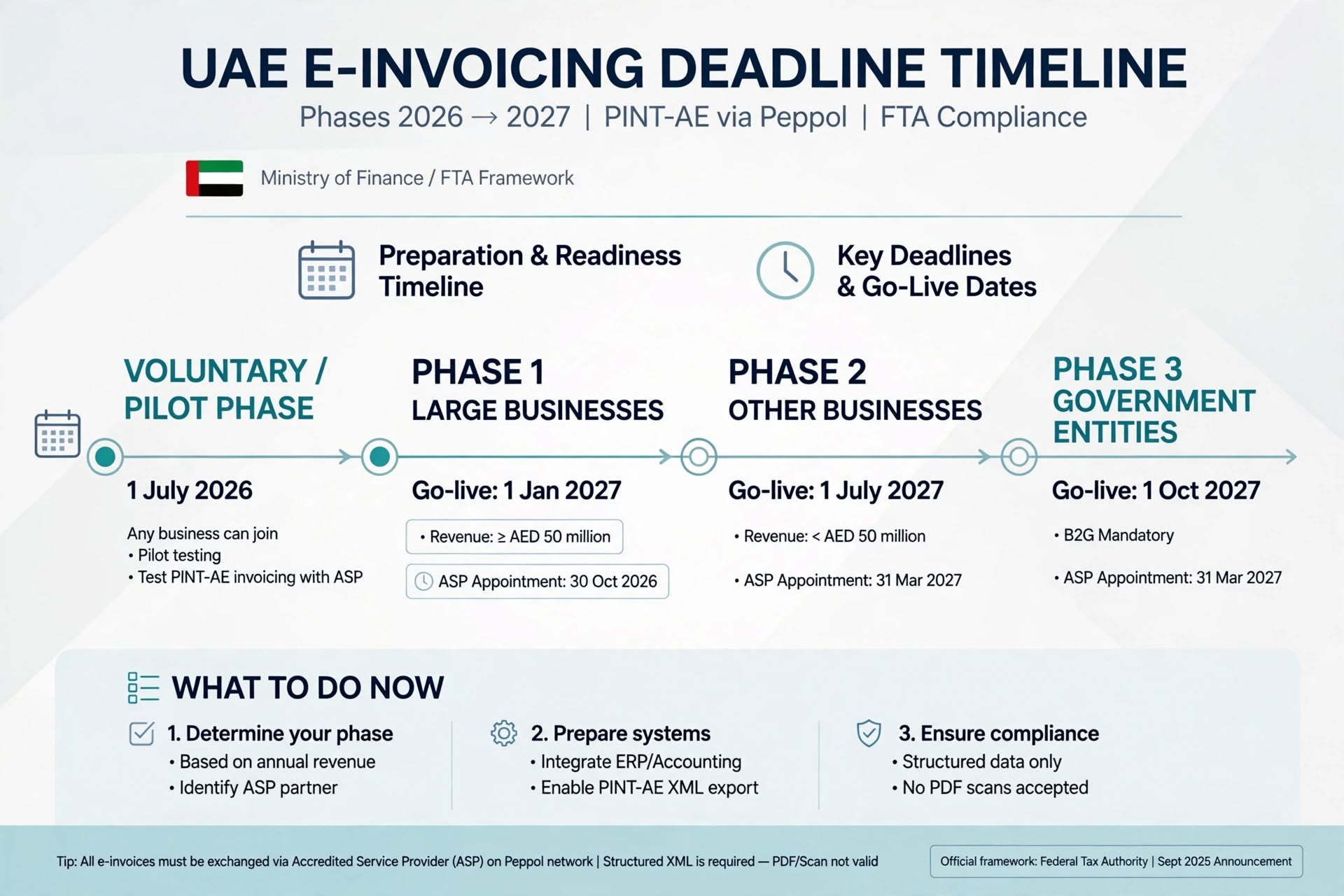
The rollout for e-invoices is phased, based on annual revenue:
| Group | ASP appointment deadline | Mandatory go-live for e-invoices |
|---|---|---|
| Voluntary / pilot phase for e-invoices | Open from 1 July 2026 | Optional |
| AED 50M+ (Phase 1) | 30 Oct 2026 | 1 Jan 2027 |
| Below AED 50M (Phase 2) | 31 March 2027 | 1 July 2027 |
| Government entities | 1 Oct 2027 |
The go-live date for e-invoices of 1 January 2027 did not change, so there is very little time for onboarding and testing.
E-Invoices Penalties in UAE
Cabinet Decision 106 of 2025 sets penalties for e-invoices once your phase begins:
- AED 5,000 per month for failing to implement e-invoices or appoint an ASP on time.
- AED 100 per e-invoice or credit note not issued on time, capped at AED 5,000 per month.
- AED 1,000 per day for failing to notify FTA of a system malfunction for e-invoices.
How E-Invoices Will Affect Your Accounting
- Cleaner data is essential for e-invoices. Customer names, TRNs, addresses must be accurate.
- Credit notes follow same e-invoices rules. Must be transmitted electronically.
- Record storage for e-invoices. Electronic records need to be stored within UAE.
- Faster reconciliation with e-invoices. Structured data makes VAT returns quicker.
Benefits of E-Invoices for Your Business
- Fewer errors in e-invoices. Data is checked before reaching customer.
- Faster payments with e-invoices. Structured e-invoices processed automatically.
- Less manual work for e-invoices. Automated creation and delivery.
- Easier VAT reporting via e-invoices. Clean data makes audits simpler.
Common E-Invoices Mistakes to Avoid
- Waiting until deadline for e-invoices.
- Assuming PDF is enough for e-invoices.
- Ignoring credit notes in e-invoices system.
- Leaving customer data messy for e-invoices.
7 Steps to Prepare for E-Invoices
- Confirm your phase for e-invoices.
- Choose an Accredited Service Provider for e-invoices.
- Review accounting software for e-invoices compatibility.
- Clean up master data for e-invoices.
- Map your e-invoices processes.
- Test e-invoices before go-live.
- Train your team for e-invoices workflow.
How Smarty Counsel Can Help With E-Invoices
As a UAE accounting firm, Smarty Counsel helps businesses get ready for e-invoices without disrupting operations:
- E-invoices readiness assessments
- Cleaning accounting data
- Support selecting ASP for
- Ongoing bookkeeping for compliance
Ready for e-invoices? Contact Smarty Counsel today.
Disclaimer: For general info on e-invoices only. Confirm current requirements with MoF or FTA. For details, see Federal Tax Authority.
Frequently Asked Questions
What is UAE e-invoicing?
UAE e-invoicing is the electronic creation, exchange and storage of invoices in a structured digital format through the UAE’s Electronic Invoicing System. Invoices are sent via an Accredited Service Provider, which validates and reports them to the authorities.
When does e-invoicing become mandatory in the UAE?
For businesses with annual revenue of AED 50 million or more, it becomes mandatory on 1 January 2027. For businesses below AED 50 million and government entities, the mandatory date is 1 October 2027. A voluntary and pilot phase started on 1 July 2026.
Is e-invoicing mandatory for small businesses in the UAE?
Yes, in principle. Businesses below the AED 50 million threshold fall into the second phase, with an ASP to be appointed by 31 March 2027 and implementation by 1 july 2027, unless an exclusion applies.
Do I need to be VAT-registered to use e-invoicing?
No. The system applies broadly to persons conducting business in the UAE, and VAT registration is not what determines whether you are in scope.
Does e-invoicing apply to B2C sales?
No. The mandate covers B2B and B2G transactions. B2C transactions are not subject to mandatory e-invoicing.
What are the penalties for not complying with UAE e-invoicing?
Penalties include AED 5,000 per month for not implementing the system or appointing an ASP on time, and AED 100 per late invoice or credit note, capped at AED 5,000 per month. Other fines apply for failing to report malfunctions or changes to registered data.
Can I still send PDF invoices?
Once your mandatory phase starts, in-scope invoices must be issued and transmitted through the Electronic Invoicing System in the required structured format. A PDF alone will not be enough for those transactions.
Can I start e-invoicing before my deadline?
Yes. Voluntary implementation has been open since 1 July 2026. It lets you test the process and fix issues before the mandatory date.
How can an accounting firm help with e-invoicing?
An accounting and bookkeeping firm can assess your readiness, clean your financial data, help you choose and onboard with an ASP, and keep your VAT and bookkeeping aligned with the new rules
How much does UAE e-invoicing cost?
Costs depend on your chosen Accredited Service Provider, your invoice volume and how much work your accounting system needs for integration. Ask several providers for quotes and compare setup fees, monthly charges and support.
What should I do first to prepare for UAE e-invoicing?
Start by confirming which phase your business falls into, then shortlist Accredited Service Providers and check that your accounting software can connect to them. Cleaning your customer and supplier data at the same time will save problems later.