UAE E-Invoicing • Invoice Deadlines • VAT Compliance
How Many Days to Issue an E-Invoice in the UAE?
Understand the 14-business-day e-invoicing rule, the 14-calendar-day VAT invoice deadline, how to identify the correct starting date, and what businesses must do to issue and transmit invoices on time.
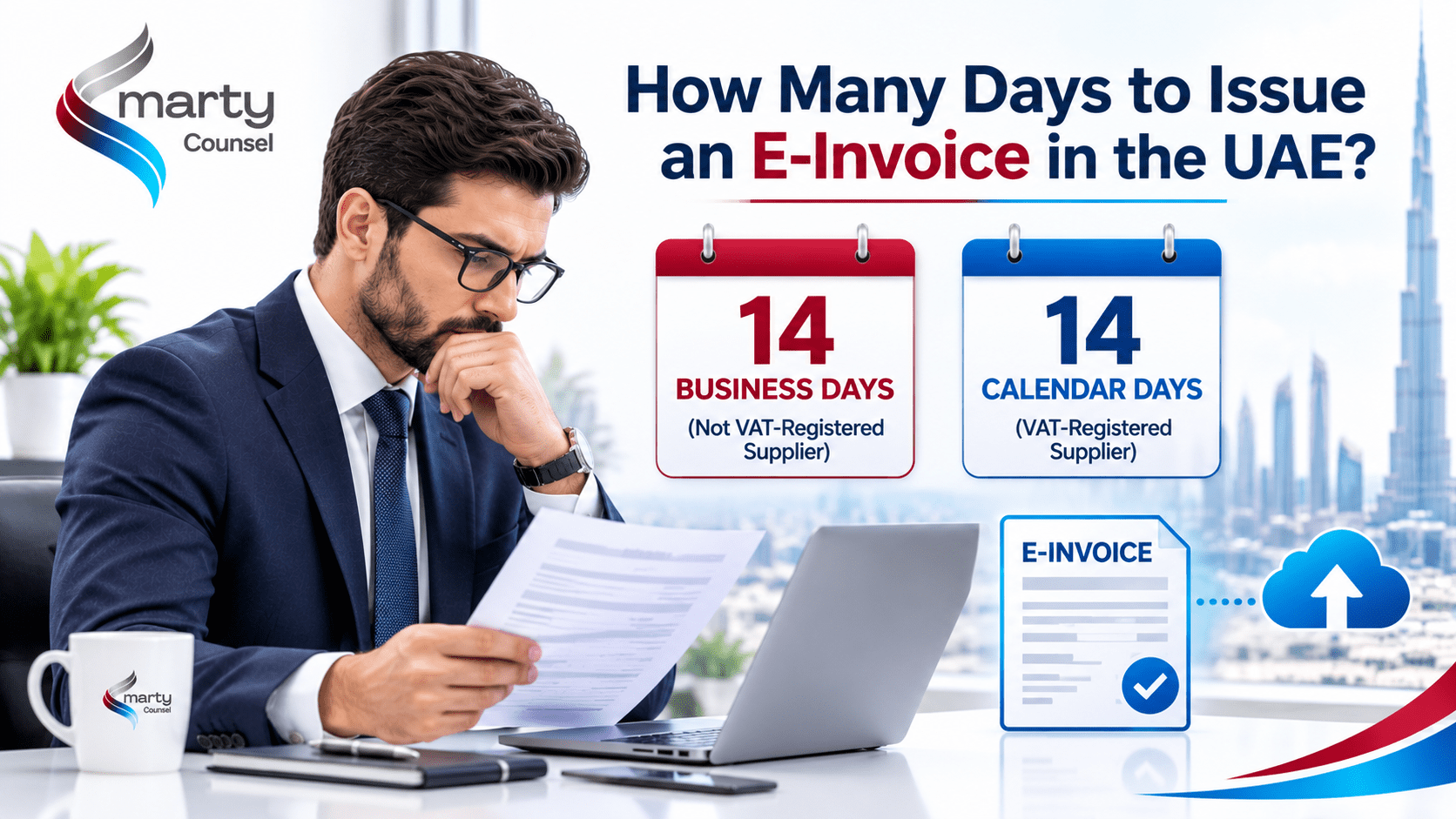
In the UAE, the deadline is not always the same for every business. An issuer who is not VAT-registered generally has 14 business days to issue and transmit an in-scope e-invoice. A VAT-registered supplier issuing a tax invoice for a taxable supply generally has 14 calendar days from the VAT date of supply.
- Non-VAT-registered issuer: 14 business days from the Date of Business Transaction under the amended e-invoicing decision.
- VAT-registered supplier issuing a tax invoice: generally 14 calendar days from the date of supply under Article 67 of the UAE VAT Law.
Ministerial Decision No. 197 of 2026 changed the e-invoicing deadline from 14 days to 14 business days from 1 October 2026. However, the amended rule remains subject to the VAT-law timeline for a VAT registrant. Do not automatically apply 14 business days to every electronic invoice.
This guide explains the UAE position as at 23 November 2026. It uses the Ministry of Finance’s amended e-invoicing decision, the VAT Decree-Law, the VAT Executive Regulation and current FTA guidance. It is written for UAE businesses, finance teams, accountants and anyone responsible for invoice processing.
How Many Days to Issue an E-Invoice in the UAE?
The amended UAE e-invoicing framework states that an electronic invoice or electronic credit note must be issued and transmitted through the Electronic Invoicing System within 14 business days from the Date of Business Transaction, subject to the rule for VAT registrants.
Under Article 6(4) of Ministerial Decision No. 243 of 2025, where the issuer is a VAT registrant, the issuer must issue and transmit the electronic invoice and electronic credit note within the timeline prescribed by the VAT Law. Article 6(5), as amended by Ministerial Decision No. 197 of 2026, sets the 14-business-day period subject to that VAT-registrant rule.
For a VAT-registered supplier issuing a tax invoice for a taxable supply, Article 67 of the VAT Decree-Law generally requires the tax invoice to be issued within 14 days from the date of supply. The FTA has explained this as 14 calendar days. Specific exceptions, including qualifying summary invoices and certain cases requiring immediate invoicing, must be considered separately.
A simplified guide. The VAT-registered branch refers to a supplier issuing a tax invoice for a taxable supply, not automatically every commercial document created by a VAT-registered company.
14 Business Days vs 14 Calendar Days: What Is the Difference?
The difference comes from two connected but separate legal requirements. The amended e-invoicing decision has a general 14-business-day timeline for issuers who are not VAT registrants. A VAT registrant must follow the deadline prescribed by the VAT Law for its tax invoice or tax credit note.
| Document or issuer situation | General deadline | Starting point | Main legal reference |
|---|---|---|---|
| In-scope e-invoice issued by a person who is not VAT-registered | 14 business days | Date of Business Transaction | Ministerial Decision 243/2025, Article 6(5), as amended by Decision 197/2026 |
| Electronic tax invoice issued by a VAT-registered supplier for a taxable supply | 14 calendar days | VAT date of supply | VAT Decree-Law, Article 67 |
| Qualifying VAT summary tax invoice | 14 calendar days after month-end | End of calendar month of the supplies | VAT Executive Regulation, Article 59 |
| VAT tax credit note where an Article 61 event reduces output tax | 14 calendar days | Date the relevant event occurs | VAT Decree-Law, Article 62(2) |
| Non-VAT issuer’s electronic credit note | 14 business days | Date of Business Transaction under the e-invoicing decision | Decision 197/2026, amended Article 6(5) |
What Is the Date of Business Transaction?
For the general e-invoicing deadline, the Date of Business Transaction means the earlier of the date on which the business transaction occurs or the date payment is received for that transaction.
This means that the invoice clock may start before the goods are delivered or the service is completed if the business receives payment first. A company should therefore record both the transaction event and any advance payment instead of relying only on the date an accountant creates the invoice.
Example: customer pays before the work is completed
A supplier agrees to provide a service later in the month. The customer pays an advance on 4 November, and the service is completed on 12 November. For the e-invoicing definition of Date of Business Transaction, the earlier date is 4 November because payment was received first.
For a VAT-registered supplier, the date of supply must also be worked out under Articles 25 and 26 of the VAT Decree-Law. These provisions can treat payment receipt or an earlier tax invoice as the tax point. Do not assume the commercial completion date is always the correct date.
How to Identify the VAT Date of Supply
For a VAT-registered supplier, the deadline generally runs from the date of supply under Article 25 or Article 26 of the VAT Decree-Law. The right date depends on the type of transaction.
Goods
The date of supply can depend on when the goods are transferred, placed at the customer’s disposal, installed or assembled, or imported. The law uses the earliest relevant event in Article 25.
Services
For a service, the date of supply is generally linked to completion of the service, subject to earlier payment or tax-invoice events and the rules for special cases.
Periodic payments and continuous contracts
For a contract with periodic payments or consecutive invoices, Article 26 uses the earliest of the relevant events: the tax invoice date, the payment due date shown on the invoice, receipt of payment, or the expiry of one year from the date the goods or services were provided.
As a result, a monthly service contract may create several tax points during the contract. It is not always correct to wait until the final day of the overall contract.
How to Count the E-Invoice Deadline Correctly
How to count 14 business days
- Identify the Date of Business Transaction: the earlier of the transaction occurring or payment being received.
- Count business days, excluding weekends and official Federal Government holidays.
- Do not use the supplier’s own working calendar if it differs from the statutory definition.
- Use an internal deadline earlier than the legal limit so there is time to correct rejected data or transmission failures.
How to count 14 calendar days
- Identify the VAT date of supply under Article 25 or Article 26.
- For a tax-law time period, do not include the day on which the triggering event occurred.
- Count the following 14 calendar days, including weekends and holidays.
- If the last day falls on a non-business day, the Tax Procedures Law provides for the period to extend to the next business day.
The Tax Procedures Law requires tax-related time periods to be calculated using the Gregorian calendar. For a specific invoice, use the actual tax point and check for a special invoicing rule before relying on a generic calculator.
Worked Examples: When Is the E-Invoice Due?
The following examples are illustrations only. They assume no Federal Government holiday falls within the dates shown and that no special invoice exception applies.
| Example | Relevant date | Rule applied | Illustrative deadline |
|---|---|---|---|
| Non-VAT-registered supplier completes an in-scope B2B transaction and receives no earlier payment. | Monday, 2 November 2026 | 14 business days from the Date of Business Transaction | Friday, 20 November 2026, assuming the next business day is counted as Day 1 and no federal holiday intervenes. |
| VAT-registered supplier completes a one-off taxable service, with no earlier payment or invoice. | Monday, 2 November 2026 | 14 calendar days from the VAT date of supply | Monday, 16 November 2026, subject to the tax-time calculation rules and no special exception. |
| VAT-registered supplier issues a qualifying summary invoice for October supplies. | Calendar month ends 31 October 2026 | 14 days after month-end | Monday, 16 November 2026, because 14 November falls on Saturday and the Tax Procedures Law extends the final day to the next business day, assuming no public holiday intervenes. |
In the first example, the transaction date is not counted as a business day. In the second example, the tax-law period is counted from the day after the date of supply. The examples should not replace an invoice-specific calculation where advance payments, periodic billing, imports or other special rules apply.
Special Rules for Summary Invoices, Advance Payments and Credit Notes
Summary tax invoices
Some VAT-registered suppliers may issue a summary tax invoice covering multiple supplies made to the same recipient during a calendar month, where the conditions in Article 59 are met. The summary invoice must generally be issued and delivered within 14 days after the end of that calendar month. This is a specific VAT rule; it is not a general extension for every invoice.
Advance payments
An advance payment can trigger the date-of-supply rules before the goods are delivered or services are completed. For a VAT registrant, check Article 25(7) and the applicable VAT invoicing guidance. For the general e-invoicing deadline, the Date of Business Transaction is expressly the earlier of the transaction date or payment receipt.
Tax credit notes and electronic credit notes
An electronic credit note is required in relevant e-invoicing situations such as a cancelled transaction, a reduction or return of consideration, or an administrative or numerical error. Where a VAT-registered supplier must issue a tax credit note because output tax is reduced, Article 62(2) generally requires it within 14 days of the relevant event under Article 61.
For a non-VAT-registered issuer, the amended e-invoicing decision applies the 14-business-day rule to an electronic credit note. Keep a record of the event, reason for the adjustment, supporting document and date the credit note was issued and transmitted.
Issuing, Transmitting and Reporting an E-Invoice Are Different
Businesses sometimes treat these steps as if they are the same. They are related, but they are not identical.
Create the structured electronic invoice with the required transaction, supplier, buyer, tax and line-item data.
Send the invoice through the Electronic Invoicing System using the appointed Accredited Service Provider (ASP) so it reaches the recipient’s provider.
The issuer and recipient have reporting duties under the framework. The ASP facilitates the exchange and reporting of required tax data to the FTA.
Check the ASP acknowledgements and resolve rejected or failed documents. A PDF copy saved in accounting software does not prove successful e-invoice transmission.
Issuance, transmission and reporting are linked steps, but their legal requirements should not be treated as one identical deadline.
When selecting UAE e-invoicing software or an Accredited Service Provider in the UAE, check whether the service supports PINT AE validation, recipient routing, transmission acknowledgements, FTA tax-data reporting and error correction. Confirm the integration method with your accounting or ERP system before the mandatory go-live date.
Article 6(6) of Ministerial Decision No. 243 of 2025 addresses reporting to the FTA separately from the invoice issuance and transmission deadline. Article 6(7) requires the parties to fulfil their obligations through an ASP. Do not assume that the 14-day invoice deadline automatically describes every separate reporting action.
When Does Mandatory E-Invoicing Start in the UAE?
The invoice-issuance period and the mandatory e-invoicing implementation date answer different questions. The 14-day rule concerns how quickly an invoice must be issued and transmitted once the relevant system obligations apply. The rollout dates determine when a business must begin using the mandatory system.
| Business category | ASP appointment deadline | Mandatory e-invoicing date |
|---|---|---|
| Businesses with annual revenue of AED 50 million or more | 30 October 2026 — passed | 1 January 2027 |
| Businesses with annual revenue below AED 50 million | 31 March 2027 | 1 July 2027 |
| Government entities | 31 March 2027 | 1 October 2027 |
All businesses may adopt e-invoicing voluntarily from 1 July 2026. If a business opts in voluntarily, it must follow the technical e-invoicing requirements, while the applicable administrative penalty treatment differs from mandatory participation. Check the Ministry of Finance portal for the current guidance and official list of fully accredited ASPs.
What Happens If an E-Invoice Is Issued Late?
Once mandatory e-invoicing applies to a business, failure to issue and transmit an electronic invoice or electronic credit note through the required system can result in administrative penalties. Cabinet Decision No. 173 of 2026 lists a penalty of AED 100 for each electronic invoice and AED 100 for each electronic credit note, subject to a maximum of AED 5,000 per calendar month for each category of violation.
The system implementation and ASP appointment obligations have separate penalties. The current Ministry of Finance e-invoicing portal lists Cabinet Decision No. 173 of 2026 as the current penalties decision and identifies Cabinet Decision No. 106 of 2025 as repealed. Penalty exposure depends on whether the relevant obligation is mandatory for the business at the time of the failure. Voluntary adoption is treated differently under the framework.
A late invoice can also create VAT accounting and reconciliation problems, especially where the invoice date, date of supply and VAT return period do not match. Correcting the document later does not necessarily remove the original timing issue.
How to Avoid Late E-Invoices: A Business Checklist
- Identify whether the issuer is VAT-registered and whether the document is a tax invoice or a commercial electronic invoice.
- Confirm that the transaction is within the UAE e-invoicing scope and that the mandate applies to your business or you have opted in voluntarily.
- Record the date the transaction occurred and the date payment was received.
- For VAT-registered suppliers, calculate the VAT date of supply under Articles 25 and 26.
- Apply the correct 14-business-day or 14-calendar-day rule.
- Keep federal weekends and official holidays in the business-day calendar.
- Use an internal target earlier than the statutory deadline.
- Check invoice data before sending it to the ASP, including the buyer’s details, TIN/TRN where required, tax codes and line-item values.
- Monitor ASP acknowledgements and correct rejected documents immediately.
- Keep evidence of issue, transmission, recipient delivery and required FTA reporting.
- Review advance payments, periodic contracts, summary invoices and credit notes separately.
- Reconcile e-invoice records against the accounting system and VAT return.
Need Help Preparing Your UAE Business for E-Invoicing?
Smarty Counsel supports UAE businesses with accounting, bookkeeping and tax compliance processes. Businesses preparing for e-invoicing should review invoice workflows, VAT records, customer data, accounting software and ASP arrangements before their mandatory date.
Explore Smarty Counsel or contact the team to discuss your accounting and compliance requirements.
Frequently Asked Questions
1. How many days do I have to issue an e-invoice in the UAE?
Under the amended e-invoicing rule, an issuer who is not VAT-registered generally has 14 business days from the Date of Business Transaction. A VAT-registered supplier issuing a tax invoice for a taxable supply generally has 14 calendar days from the VAT date of supply.
2. Is the UAE e-invoice deadline 14 business days or 14 calendar days?
Both periods can apply, depending on the issuer and document. The 14-business-day rule applies under the amended e-invoicing decision subject to the VAT-registrant rule. VAT tax invoices generally follow the VAT Law’s 14-calendar-day period.
3. When did the 14-business-day e-invoicing rule take effect?
Ministerial Decision No. 197 of 2026 came into force on 1 October 2026 and amended Article 6(5) of Ministerial Decision No. 243 of 2025.
4. What date starts the 14-business-day period?
The Date of Business Transaction is the earlier of the date the transaction occurred or the date payment was received for it.
5. Does a VAT-registered business get 14 business days?
Not for a tax invoice for a taxable supply where the VAT Law sets the deadline. Article 6(4) of the e-invoicing decision requires a VAT registrant to follow the timeline prescribed by the VAT Law, which generally means 14 calendar days from the date of supply under Article 67.
6. Do weekends count in the 14-business-day period?
No. The e-invoicing decision defines a business day as a day other than weekends and official Federal Government holidays.
7. Does the 14-calendar-day VAT deadline include weekends?
Yes, calendar days include weekends and holidays within the period. The Tax Procedures Law provides that the triggering day is excluded and that a final day falling on a non-business day is extended to the next business day.
8. Does the deadline start when I prepare the invoice in my accounting system?
No. The statutory starting point is the relevant Date of Business Transaction or VAT date of supply. The date staff enter the invoice into accounting software does not replace the legal trigger.
9. Is a PDF invoice sent by email an official UAE e-invoice?
No. A UAE e-invoice is structured invoice data issued and exchanged electronically through the system. A PDF, scan, Word document or emailed image is not a structured e-invoice.
10. Are invoice issuance and FTA reporting the same deadline?
No. The e-invoicing decision addresses issuance and transmission separately from reporting to the FTA. An ASP facilitates the exchange and reporting process, and businesses should retain the relevant acknowledgements.
11. What is the deadline for issuing a tax summary invoice?
Where the VAT Executive Regulation allows a qualifying summary tax invoice for multiple supplies to the same recipient, it is generally issued and delivered within 14 days after the end of the calendar month in which the supplies occurred.
12. How many days do I have to issue a VAT credit note?
Where an event under Article 61 reduces output tax, Article 62(2) generally requires the VAT tax credit note within 14 days of that event. The electronic credit note must also comply with the e-invoicing system requirements applicable to the issuer.
13. What is the penalty for issuing an e-invoice late?
Cabinet Decision No. 173 of 2026 lists AED 100 for each e-invoice not issued and transmitted through the system, up to AED 5,000 per calendar month. The penalty applies when the relevant e-invoicing obligation is mandatory for the person.
14. When does mandatory e-invoicing start for UAE businesses?
Businesses with revenue of AED 50 million or more must implement the system from 1 January 2027. Other in-scope businesses below AED 50 million must implement it from 1 July 2027. Government entities have a separate 1 October 2027 implementation date.
Official UAE Sources and Further Reading
- Ministry of Finance – Official UAE eInvoicing portal, guidelines, ASP list and legislative decisions.
- Ministerial Decision No. 197 of 2026 – amendment to the e-invoicing issuance deadline, effective 1 October 2026.
- Ministerial Decision No. 243 of 2025 – Electronic Invoicing System, including the definition of Date of Business Transaction and Article 6.
- Federal Tax Authority – VAT Decree-Law, including Articles 25, 26, 62 and 67.
- Federal Tax Authority – VAT Executive Regulation, including Article 59 on tax invoices and summary invoices.
- Ministry of Finance – UAE Electronic Invoicing Guidelines, Version 2.0, 26 October 2026.
- Cabinet Decision No. 173 of 2026 – official Ministry of Finance publication on Electronic Invoicing System administrative penalties (Arabic).
- Federal Decree-Law No. 28 of 2022 on Tax Procedures – Article 49 on calculation of time periods.
Editorial responsibility and scope: Smarty Counsel is responsible for reviewing the accuracy of the information it publishes and correcting its content when relevant official requirements change. This article is based on UAE legislation and official Federal Tax Authority and Ministry of Finance material available as at 23 November 2026. It is general tax and compliance information, not a legal opinion or advice on a specific transaction. The applicable deadline depends on the issuer’s VAT status, the document, the date of supply, payment timing, transaction type and whether a special invoicing rule applies. Businesses should confirm the current position with the FTA or a qualified UAE tax adviser where their facts are not straightforward.