What Is an Accredited Service Provider in UAE E-Invoicing?
Prepared by Smarty Counsel · Last reviewed: 19 November 2026 · UAE business compliance guide
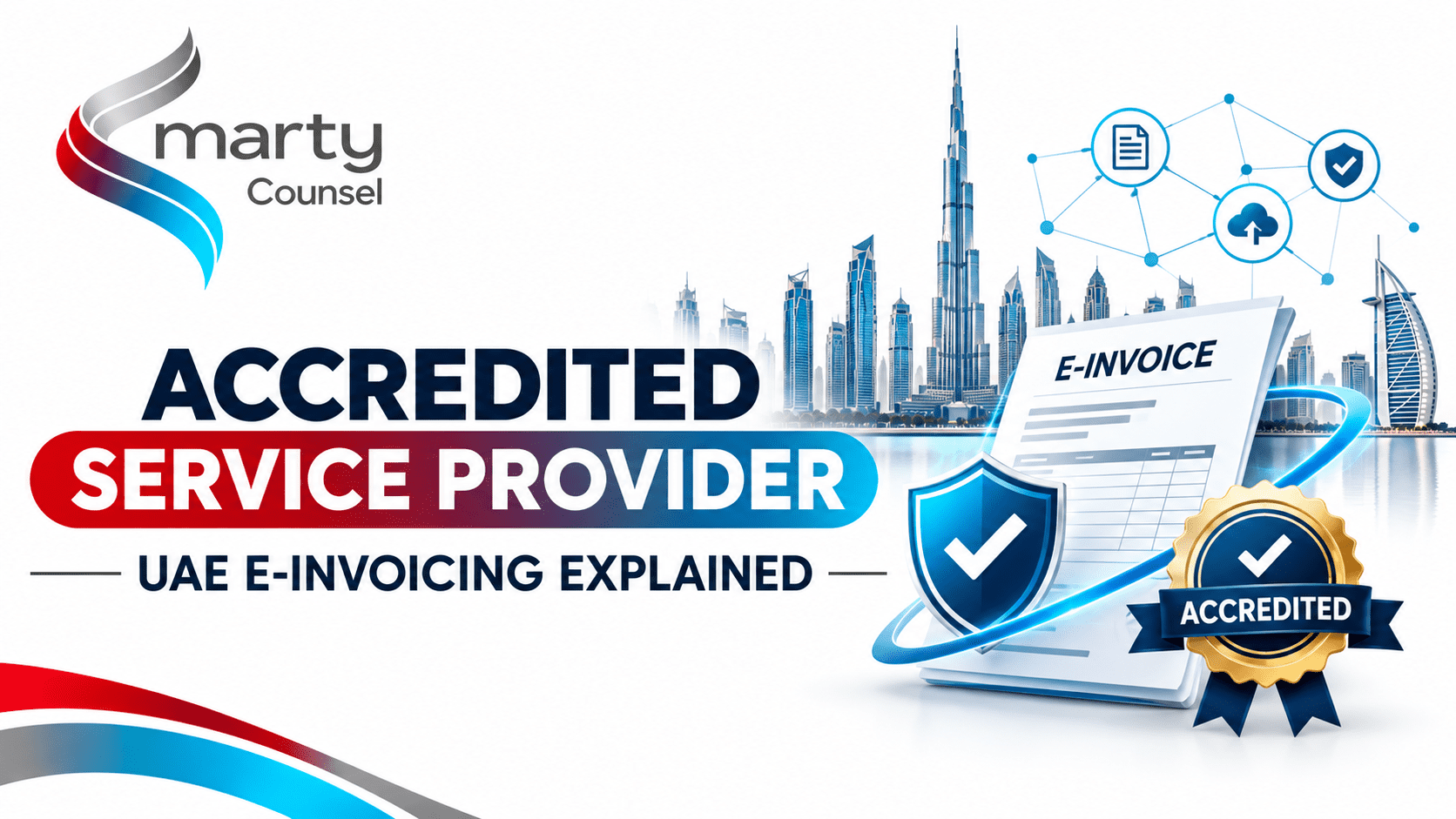
An accredited service provider in UAE e-invoicing is a service provider that has received official accreditation from the UAE Ministry of Finance to provide electronic invoicing services under the country’s e-invoicing framework. It connects a business’s accounting, billing or ERP system to the Peppol network, validates structured invoice data against UAE requirements, exchanges e-invoices with customers and reports the required tax data to the Federal Tax Authority (FTA).
This guide explains what an ASP does, how accreditation works under the current rules, how to check a provider, and what UAE businesses should compare before choosing one. It also explains what an ASP does not take responsibility for, so a business does not assume that selecting a provider automatically makes every invoice or tax treatment correct.
What Is an Accredited Service Provider in UAE E-Invoicing?
An Accredited Service Provider, usually shortened to ASP, is an organisation that has completed the UAE’s service-provider accreditation process and is authorised by the Ministry of Finance to provide e-invoicing services in the UAE.
The ASP acts as a regulated technology intermediary. A business creates invoice information in its accounting or ERP system. The ASP receives that data, checks the required fields and technical rules, prepares it in the required structured format, and sends it through the Peppol-based exchange network. The ASP also reports the relevant tax data to the FTA.
The UAE Ministry of Finance maintains the official register of accredited providers. The register is published under Article 13 of Ministerial Decision No. 168 of 2026 and is updated periodically. It includes provider names and accreditation numbers, allowing businesses to check the identity of the provider they intend to appoint.
Official register: UAE Ministry of Finance – Accredited Service Providers.
Why Do UAE Businesses Need an Accredited Service Provider?
Under the UAE e-invoicing framework, businesses in scope must use the designated electronic invoicing system to exchange and report covered invoices. They do not simply email a PDF to a customer or upload a spreadsheet directly to the FTA. They engage an ASP to connect their business systems to the required network and reporting process.
The provider gives the business a route to exchange structured invoices with other participants while supporting the technical requirements of the UAE system. This matters for both accounts receivable and accounts payable. A business must be able to issue covered invoices and receive them through its e-invoicing connection.
Structured invoice exchange
The ASP supports the exchange of machine-readable invoice and credit-note data rather than relying only on PDF attachments or scanned documents.
Technical validation
The provider checks invoice data against the UAE data dictionary and applicable technical validation rules before transmission.
Network connectivity
The ASP connects the business to the Peppol-based exchange framework and helps route invoices to the buyer’s endpoint.
Tax-data reporting
The provider reports the required tax data to the FTA as part of the decentralised e-invoicing framework.
What Does an Accredited Service Provider Actually Do?
An ASP is more than a company that gives a business access to an online invoice portal. Its role covers several connected technical and operational functions.
1. Validates invoice information
The provider checks invoice data against the applicable UAE data dictionary and technical rules. Depending on the document and transaction, this can include supplier and buyer identifiers, invoice number and date, line details, currency, totals, tax categories, VAT amounts and required references.
Validation helps identify missing or incorrectly formatted information before an invoice is exchanged. It does not mean the provider has independently verified the commercial transaction or confirmed that the business has chosen the correct VAT treatment. The business remains responsible for the accuracy and tax substance of the information it supplies.
2. Maps data into the PINT-AE format
Businesses may store invoice information in different accounting and ERP systems. The ASP supports the mapping of that source data into the structured format required for UAE e-invoicing, known as PINT-AE, which is based on the Peppol framework and the UAE’s data requirements.
This step is important because a PDF invoice or a spreadsheet is not, by itself, a structured e-invoice. The underlying invoice information must be represented in a machine-readable format that systems can process.
3. Exchanges invoices through Peppol
The ASP operates the relevant connection to the Peppol network. It helps identify the buyer’s electronic address or endpoint and routes the structured invoice to the buyer’s service provider. The buyer then receives the invoice through its own connection and business system.
4. Reports tax data to the FTA
The UAE model has two connected activities: invoice exchange and tax-data reporting. The ASP validates the invoice fields, exchanges the document through the Peppol network and reports the required tax data to the FTA’s designated reporting corner.
5. Provides operating support and error information
A business should understand how its ASP returns validation errors, communicates transmission status, handles outages and supports corrections. These service details should be documented in the onboarding plan and service-level agreement rather than left as informal promises.
How Does the UAE Peppol Five-Corner Model Work?
The UAE uses a decentralised five-corner model. Each corner represents a participant or part of the exchange and reporting process.
| Corner | Participant | Role |
|---|---|---|
| Corner 1 | Supplier | Creates the invoice in its accounting, billing or ERP system. |
| Corner 2 | Supplier’s ASP | Validates and sends the structured invoice, and reports the required tax data. |
| Corner 3 | Buyer’s ASP | Receives the invoice through the network and makes it available to the buyer. |
| Corner 4 | Buyer | Receives the invoice in its business or accounting process. |
| Corner 5 | Federal Tax Authority | Receives the tax data reported through the framework. |
The buyer and supplier do not need to build a direct connection to each other. Their respective ASPs support interoperability through Peppol. The supplier’s ASP also reports the relevant tax data to the FTA.
This is why the provider should be assessed as part of the business’s finance and technology setup. It needs to work with the systems that create outgoing invoices and process incoming invoices, not just provide an attractive dashboard.
What Does “Accredited” Mean Under the UAE’s Current Rules?
Accreditation is the official approval issued by the Ministry of Finance to a service provider under the UAE e-invoicing framework. It is not simply a marketing label or a general certificate showing that a company works with electronic documents.
Ministerial Decision No. 168 of 2026
The current accreditation framework is governed by Ministerial Decision No. 168 of 2026, which took effect on 1 October 2026. The Ministry of Finance announced that this decision repealed Ministerial Decision No. 64 of 2025 and its amendments, including Decision No. 56 of 2026.
A major change was the removal of the old pre-approval stage. Under the current framework, a provider must complete the defined accreditation assessment and testing requirements before it receives accreditation. Providers that had received preliminary approval under the previous rules were given a transitional period to complete the newer requirements.
What does a provider need to demonstrate?
The Ministry’s accreditation service describes eligibility requirements that include active Peppol certification and successful OpenPeppol conformance testing, at least two years of experience operating and managing an e-invoicing system, compliance with company and tax registration requirements, information-security controls, self-declarations and insurance requirements.
The Ministry’s published criteria also address protection of invoice data, product security, maintenance and service continuity. A provider may use a third-party Peppol product or outsource parts of its service, but the Ministry has stated that the accredited provider remains responsible for compliance and service delivery.
See the official Ministry of Finance announcement on Decision No. 168 of 2026 and its ASP accreditation service and eligibility requirements.
How to Check Whether an ASP Is Officially Accredited in the UAE
Do not rely only on a provider’s website, sales presentation, logo or statement that it is Peppol-ready. Verify the entity against the Ministry of Finance register before entering into a contract.
- Open the official Ministry of Finance register. Use the accredited ASP list, rather than an old pre-approved-provider PDF.
- Match the legal company name. Check the exact legal name and accreditation number. A trading brand, parent company, reseller or technology partner may not be the entity named on the register.
- Confirm which company will sign your contract. Ask whether the contracting entity is the same accredited entity. If another group company or reseller is involved, get the service and accountability structure in writing.
- Ask about the actual product. Confirm which platform, Peppol Access Point and integration tools will process your invoices. If the provider uses a third-party product, ask who operates it and who is responsible for service issues.
- Recheck before go-live. Accreditation status and the published register can change. Save the register details you checked and repeat the check before production onboarding if a significant period has passed.
The Ministry says the accredited-provider list is updated periodically. Use the live page as the reference point; do not copy a fixed list of provider names into an internal procurement document and assume it will remain current.
ASP vs Peppol Provider vs E-Invoicing Software: What Is the Difference?
These terms are related, but they do not mean the same thing. Understanding the difference helps prevent a business from buying software that cannot perform the regulated role it needs.
| Term | What it means | What a UAE business should check |
|---|---|---|
| Accredited Service Provider (ASP) | A provider granted accreditation by the UAE Ministry of Finance to provide e-invoicing services in the UAE. | Check the legal entity and accreditation number on the current official MoF register. |
| Peppol Service Provider | A provider that operates under the Peppol interoperability framework and its relevant agreements and conformance requirements. | Peppol status is important, but it does not by itself prove UAE Ministry of Finance accreditation. |
| E-invoicing software | A software product used to create, manage, map, validate or exchange invoice information. | Check whether the software is delivered by an accredited ASP or is integrated with one. Software alone is not proof of accreditation. |
| Implementation or accounting partner | A consultant or service firm that helps prepare data, systems, workflows or accounting processes. | Confirm whether it is itself the accredited ASP or works alongside a separate provider. Do not confuse advisory support with regulated transmission services. |
A software company may provide a useful integration layer, and a consultant may help prepare the business’s records. However, the business should identify which accredited entity is responsible for the e-invoicing service itself.
How to Choose an Accredited Service Provider in the UAE
After confirming accreditation, compare the provider’s service against your business’s actual requirements. The Ministry of Finance’s own selection guidance recommends assessing company background, geographical reach, product ownership, integration, data management, compliance, security, support, pricing and scalability.
1. Check experience and UAE market knowledge
Ask how long the provider has operated e-invoicing services, how long it has worked within the Peppol framework and what experience it has supporting UAE businesses. Ask whether it understands your industry, transaction types and operating structure. International experience can be helpful, but it should not replace knowledge of UAE-specific PINT-AE and tax-data requirements.
2. Understand product ownership and subcontracting
Ask whether the ASP owns the platform or uses a third-party product. Neither arrangement should be judged by the label alone. The important questions are who operates the technology, who maintains it, where support is provided, how updates are managed and which accredited entity remains accountable to your business.
3. Test compatibility with your ERP and accounting software
Check whether the provider supports your existing accounting software, ERP, billing platform, point-of-sale system and middleware. Ask about APIs, connectors, data formats, test environments, batch processing, implementation responsibilities and the cost of custom integration.
Do not accept a general statement such as “we integrate with all ERPs” without a technical review. Ask the provider to map the systems and invoice flows your business actually uses.
4. Review security and data management
Ask how the provider protects invoice and customer information. Discuss encryption in transit and at rest, multi-factor authentication, access controls, security monitoring, incident reporting, backup arrangements and business continuity. Ask where data is hosted, how long it is retained, how it can be retrieved and how the provider will support an FTA request for records.
5. Examine support and service-level agreements
Confirm support hours, escalation contacts, response and resolution targets, service availability commitments, planned maintenance notifications and outage procedures. Ask what happens when the ASP, your ERP or a network connection is unavailable. Make sure the contract explains how delayed or failed transmissions are handled.
6. Understand the pricing structure
Compare setup fees, integration charges, subscription fees, invoice-volume tiers, transaction charges, additional legal entities, storage, support, training and custom development. Ask how incoming and outgoing invoices are counted and whether credit notes or other document types are priced separately.
7. Consider growth and cross-border needs
Choose a platform that can support expected invoice volumes, additional business entities and future system changes. If your company trades internationally, ask how the provider handles overseas customers that are not on Peppol and whether it supports the other jurisdictions relevant to your group.
Questions to Ask Before Signing an ASP Contract
Use the questions below during procurement discussions. Ask for written answers and include important commitments in the contract or service-level agreement.
- What exact legal entity on the Ministry of Finance register will provide the service, and what is its accreditation number?
- Will the accredited entity itself sign the contract and remain responsible for service delivery?
- Does the solution support PINT-AE and the applicable UAE data dictionary and validation rules?
- Can you demonstrate integration with our accounting, ERP, billing and POS systems?
- How will you onboard our legal entities, tax identifiers, branches and buyer/supplier endpoints?
- What is included in the 100 free annual e-invoice exchange and reporting services?
- What are the fees for setup, integration, additional invoices, extra entities, support and data storage?
- Where will invoice data be hosted, stored and archived, and how can we export it if we change provider?
- What are your uptime commitments, support hours, escalation process and incident-notification timelines?
- How are validation errors, rejected documents, credit notes and transmission failures handled?
- What testing will be completed before production and who signs off the test results?
- What happens to our data and service access if the contract ends or the provider’s accreditation changes?
What Should a UAE Business Prepare Before Onboarding?
Choosing an ASP is only one part of implementation. The business must also prepare its records, invoice processes and systems. A provider cannot reliably map information that is missing, inconsistent or incorrectly maintained in the source system.
Map legal entities
List the legal entities, tax identifiers, branches, VAT-group relationships and business locations that issue or receive invoices.
Review invoice data
Check customer and supplier master data, item descriptions, tax categories, invoice references, currencies, totals and credit-note processes.
Map transaction flows
Document B2B, B2G, purchases, sales, self-billing, exports, recurring invoices and any POS or billing-system flows relevant to the business.
Agree the integration design
Confirm how invoice data will move from the ERP or accounting platform to the ASP and how status messages and received invoices return.
Test real scenarios
Test standard invoices, credit notes, tax categories, foreign customers, group entities, exceptions and high-volume processing before go-live.
Assign ownership
Give finance, tax, IT and procurement clear responsibilities for data quality, approvals, monitoring, support and record access.
Businesses that need to improve the quality of their underlying records should review their accounting and bookkeeping processes before integrating them with an e-invoicing platform. E-invoicing makes data exchange more structured; it does not repair unreliable customer records, incomplete ledgers or incorrect tax coding by itself.
Special Considerations for VAT Groups and Overseas Customers
VAT groups
The FTA’s published FAQ says each member of a VAT group must have an endpoint through a UAE ASP. When an invoice is issued, the group’s TRN is used, while the endpoint details should identify the particular group member carrying out the transaction. Businesses should therefore map every group member and its invoice flows with the selected provider rather than assuming one group registration automatically covers every entity’s endpoint.
Overseas customers
An overseas buyer does not necessarily need to join the UAE e-invoicing network. The FTA’s FAQ explains that where a foreign buyer is already registered on Peppol, its endpoint can be used. Where it is not registered, the prescribed approach can involve a dummy endpoint; the UAE seller’s ASP still reports the required tax data to the FTA, while the seller sends the invoice to the overseas customer outside Peppol, for example by email.
Because cross-border arrangements can depend on the transaction and current technical guidance, businesses should confirm the precise process with their ASP and tax adviser before relying on a single workflow for every overseas customer.
One ASP for sending and receiving
The FTA says each business entity must use the same ASP for both sending (accounts receivable) and receiving (accounts payable) e-invoices. Include both sides of the process when comparing provider functionality, costs and integration support.
What an ASP Does Not Do: Business Responsibilities and Common Misunderstandings
Accreditation confirms that a provider has met the relevant requirements to offer e-invoicing services. It does not transfer the business’s own legal, accounting or tax responsibilities to the provider.
| Common misunderstanding | What businesses should understand |
|---|---|
| “The ASP guarantees our VAT returns are correct.” | The provider validates invoice data and reports tax data. The business must still apply the correct VAT treatment and maintain accurate accounting records. |
| “Our PDF invoice is already an e-invoice.” | A PDF, scan or email attachment is not, by itself, a structured e-invoice under the UAE framework. |
| “Any Peppol provider is automatically approved in the UAE.” | Peppol capability and UAE Ministry of Finance accreditation are separate checks. |
| “Our accounting software supplier must also be the ASP.” | The software may integrate with a separate accredited provider. Identify the entity performing the regulated service. |
| “Once the ASP is selected, our implementation is complete.” | The business still needs clean data, integration, testing, staff training, control procedures and ongoing monitoring. |
| “Accreditation means the provider will suit every business.” | Accreditation is a regulatory eligibility filter. Integration quality, support, security, pricing and operational fit still need to be assessed. |
Businesses should also keep their broader tax and accounting records in order. For related UAE tax information, see Smarty Counsel’s guide to UAE corporate tax and tax rates. The correct treatment of an individual transaction should be checked against the applicable legislation and official guidance.
Frequently Asked Questions
1. What is an accredited service provider in UAE e-invoicing?
It is a service provider officially accredited by the UAE Ministry of Finance to provide electronic invoicing services under the UAE framework. It supports invoice validation, structured data exchange through Peppol and reporting of the required tax data to the FTA.
2. Who accredits e-invoicing service providers in the UAE?
The Ministry of Finance grants accreditation under the current framework. The FTA is involved in the e-invoicing system and receives the tax data reported through the framework. Businesses should use the Ministry’s official ASP register to verify providers.
3. Is Peppol certification the same as UAE ASP accreditation?
No. Peppol certification and conformance are part of the technical requirements, but a provider must also obtain accreditation under the UAE Ministry of Finance framework. Check the official UAE register.
4. Can a business use its existing accounting software instead of an ASP?
A business can continue using compatible accounting or ERP software as its source system, but it must arrange for covered e-invoice exchange and reporting through an accredited ASP. The software may connect to the ASP through an API, connector or another agreed integration.
5. Can a business use one ASP to send invoices and another to receive them?
The FTA’s published FAQ says each business entity must use the same ASP for both sending and receiving e-invoices. Confirm the setup for each legal entity with the selected provider.
6. Are there 100 free e-invoices from an ASP every year?
The Ministry’s selection guide says an ASP must provide each end-user with 100 free e-invoice exchange and reporting services per annum, starting from the date the end-user agreement is signed. Ask the ASP how it defines and counts a service and what other charges apply. It should not be read as making the complete software subscription or all implementation services free.
7. Can an ASP use a third-party e-invoicing platform?
Yes. The Ministry has stated that providers may use third-party Peppol service-provider products or outsource parts of the service, while retaining responsibility for compliance and service delivery. Businesses should ask which product is used and who is contractually accountable.
8. Does an ASP guarantee that an invoice is tax compliant?
No. The ASP performs technical validation and reporting functions. The business remains responsible for the accuracy of its source data, the commercial details and the correct tax treatment. A technically accepted invoice does not replace professional tax review where needed.
9. Where can I find the official list of UAE accredited service providers?
Use the Ministry of Finance’s accredited ASP register. It is updated periodically and includes provider names and accreditation numbers.
10. What should I compare when choosing an ASP?
Compare current accreditation, legal entity, experience, UAE and industry knowledge, PINT-AE capability, ERP integration, security, data retention, service levels, support, pricing, the 100 free annual services and how easily you can export your records if you change provider.
Preparing Your UAE Business for E-Invoicing?
Choosing an accredited provider is one part of the project. Your business should also review its invoice data, accounting processes, tax records and system integrations before onboarding. Smarty Counsel supports UAE businesses with accounting and bookkeeping services that help establish reliable financial records and processes.
Explore Accounting & Bookkeeping ServicesThe following UAE government materials were used to prepare this guide. Check the live official pages for later amendments or updated technical guidance.
- UAE Ministry of Finance – eInvoicing portal, guidelines and legislation
- UAE Ministry of Finance – Accredited Service Providers register
- Ministry of Finance – Decision No. 168 of 2026 announcement, 9 October 2026
- Ministry of Finance – Accreditation service, conditions and requirements
- Ministry of Finance – Considerations for Selecting an Accredited Service Provider, Version 1.1, 28 October 2026
- Federal Tax Authority – UAE e-Invoicing FAQs
Editorial review date: 19 November 2026. This article is general information for UAE businesses and is not a substitute for advice on a specific transaction, tax position or contract. Verify current requirements with the Ministry of Finance, the FTA and your appointed professional advisers.